The Moss Institute of Natural History

Field Guide No. 47

The Plodamouse: A Natural History

Plodamus grumpicus Moss, 1958

Narrated by Sir Reginald Moss

A plodamouse crossing open ground at its customary pace. It has seen us. It does not care for us.

Dawn, at the edge of the meadow. The plodamouse has been awake for some time.

Plate I

External Anatomy of an Adult Specimen

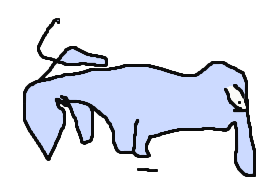
An adult plodamouse in profile, facing right. Gray-blue, heavily outlined, and visibly displeased to be included in a book.
Fig. 1. P. grumpicus, lateral view. Drawn from life. The specimen would not hold still, and then held far too still.
  1. Dorsal flap. Purpose unknown. Possibly decorative. Possibly an error.
  2. Tail. Prehensile in theory. Never yet observed holding anything.
  3. Brow. Permanently lowered. Can, under provocation, be lowered further.
  4. Trunk. Used for balance, foraging, and the expression of quiet disappointment.
  5. Hind flap. Either a leg or an opinion. Specialists remain divided.
  6. Ground mark. Its shadow. The plodamouse brings its own.
Specimen
P‑0001
Species
Plodamus grumpicus Moss, 1958
Collected
The far side of a field
Length
Variable, depending on mood
Condition
Unimpressed

Part II

Field Guide Entries

§ 1

Habitat

The plodamouse occupies the temperate margins: verges, lay-bys, the far side of fields. It is rarely found at the centre of anything.

It prefers flat ground, mild weather, and to be left alone. It has been recorded, on one occasion, inside a computer.

§ 2

Diet

Chiefly grass, which it eats without enthusiasm. It will accept a biscuit, provided the biscuit is brought to it.

It does not drink so much as stand near water, disapprovingly, until it is somehow no longer thirsty.

§ 3

Behaviour

It plods. Observers have recorded speeds of up to one plod per second, though rarely for long.

When startled, it does not flee. It simply becomes slightly more annoyed, and continues.

Scientists have debated the dorsal flap for decades. The plodamouse will not be drawn on the matter.

§ 4

Mating Display

At the onset of spring, the male raises its dorsal flap and stands perfectly still for up to four hours.

The display is largely unsuccessful.

§ 5

Vocalisations

A single call has been documented: a low, sustained exhale, delivered through the trunk, most often at dusk or when asked to do something.

Listen. That low exhale. Some call it a sigh. It is a sigh.

§ 6

Conservation Status

Mildly Annoyed

  1. PL
  2. UB
  3. MA (current status)
  4. CX
  5. LV

Its numbers are stable. Its mood is not.
Part III

Field Footage

“We waited eleven days for this footage. The plodamouse waited with us, out of spite.”
Catalogue of field reels
ReelTitleRunning timeStatus
IThe Long Walk to Water11 minAwaiting development
IIA Stick, and What Came of It4 minAwaiting development
IIIThe Display (Largely Unsuccessful)4 hr 2 minUnder review
IVDusk, and a Sigh40 secAwaiting development

Forthcoming from the Institute

Migration Season

An interactive study, in which you are the plodamouse

“Every autumn, the plodamouse migrates. No one knows where. Neither does it.”

Visit the film crew’s encampment

Coming soon

Archive item 0000 · Restricted

Lost Footage

The original field sketch: a gray-blue plodamouse, outlined in thick, wavering black, on a plain white ground. It is exactly as cross as it is today.

“The earliest known record of the species. It has not been retouched. It could not be.”

Original field sketch by Jacob Tatko, drawn in Scratch on a Raspberry Pi. The first person ever to observe a plodamouse, and the reason any of us know it exists.